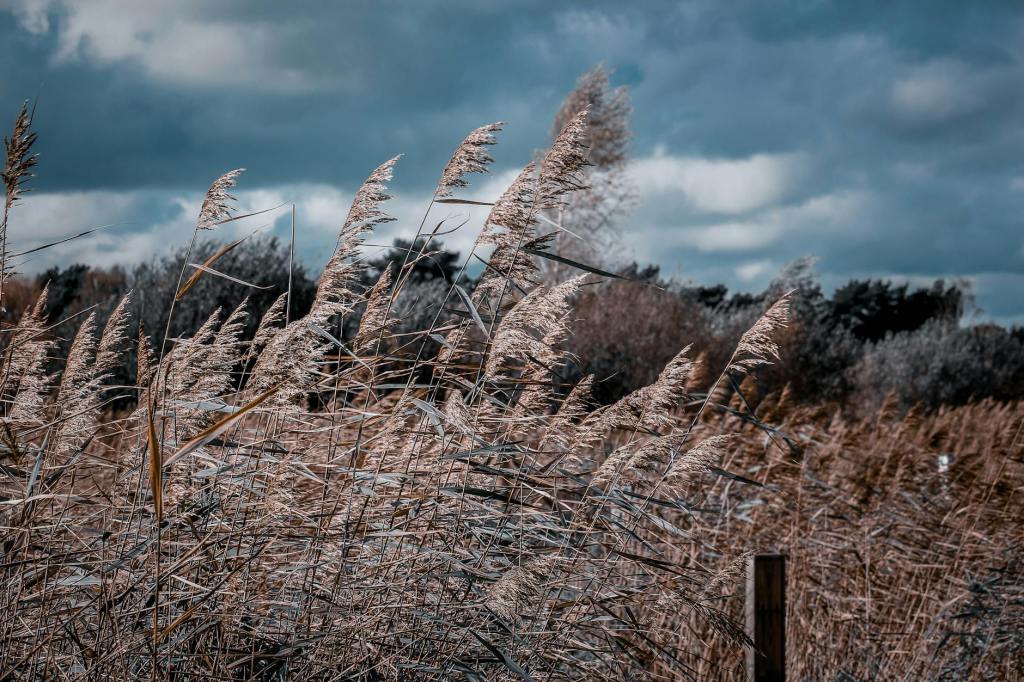
The wind brushed gently over the green leaves, caressed the long stalks of spring-colored grass, and parted like silk around the tree trunks.
It whistled through the canyons, swirled in the caves, and whooshed over the rocks.
Sometimes the bright, hot sky would spur the wind forward with vigor, making it rise to meet the clouds in a cheerful, playful greeting. Other times, the dark, cool earth would make it sluggish and sleepy, slinking down to drift gently over the surface.
It could even become still and quiet, barely moving but with the breath of animals, either fast and shallow or slow and deep.
There were times when the wind could not help but be swept away by opposing forces, twirling in a long dance between them that became shorter and shorter, faster and faster. Where the small drops of water gathered above, casting shadows on the earth too great for the sun, light would be supplied instead by powerful, jagged slashes that cut down to the earth, searing the wind where it touched.
The crude, white-hot light existed only for a second, and as if its brightness and heat were not enough to be remembered by, the second it vanished from sight it let out a monstrous roar; death itself not enough to contain it.
The wind had no preferences for one form over another. It only was. But the fierce, electric phenomenon that occurred when it was swept into the clouds’ frenzy felt like a power that happened too far from the wind’s control to fully grasp.
The wind did not have complete control — or perhaps any — over other destinations, directions, or velocity, but at least they held the semblance of something within possibility. The white-hot slashes that carved their way through space not ready for them, felt, to the wind, a little too volatile and unstable to be allowed so frequently.
But the wind was still the wind. So it went where the forces directed. It passed by, and over, and through, just about everything in this world. But it also knew there were places it could not go, at least not yet. Not until it wore away all the earth above it.
It caught glimpses of these secret, still places — where it swooshed above a hole in the ground, feeling the absence of dirt or rock or undergrowth in a small, cold diameter. The wind found solace in the fact that the greatest, largest light — the one that was so big it could radiate over half the world at once — could not reach these places either.
But perhaps someday. The wind wondered if the sun yearned to reach those places as well, and was growing hotter in its impatience; it seemed more often that the world’s forces were driven into a frenzy, resulting in that familiar feeling of precariousness teetering on the brink of existence, one that could be ripped away at any moment.
Perhaps someday, though, the wind could fulfill both their wishes and wear everything down and away, further, deeper, until they had finally reached every point.
The wind felt the sun’s warmth slowly disappear in one hemisphere and reappear in the other. The earth, as well as the wind, were always at the sun’s mercy. Neither could exist without it.
And the wind knew it would not exist without the earth, from the moment the air first breathed and gave it form.
Perhaps, then, the wind and the sun did not need to uncover all of the earth’s secrets; not if it meant withering it down to nothing. The wind wasn’t even sure it could do such a thing, as the earth was vast and made of all kinds of hardy minerals that barely flinched even in the most turbulent storm, and still remained intact after millions of years of being bombarded with the tiny, never-ending particles the wind carried.
The wind swooshed over the familiar paths in the earth’s atmosphere for the countlessth time. The fates of the wind, the earth, and the sun were intertwined in an ever-evolving, complex dance. One that would unfurl like sails carried over the sea, a ship gliding forward over turning waves. Except as far as the wind could tell, this sea had no shore. It was an endless, vast, circular infinity that only ended when it began. And begin again it would.

Leave a comment